
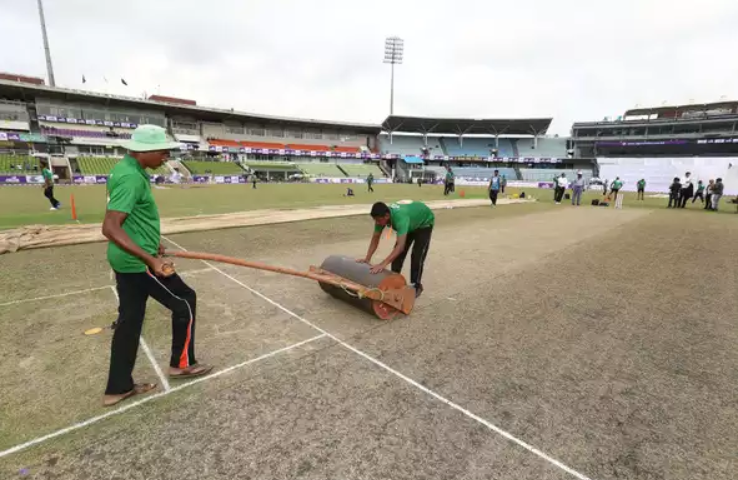
Bangladesh Cricket Board officials said on Friday that they never requested the grounds committee to prepare a low and slow wicket at the Sher-e-Bangla National Cricket Stadium.
Nazmul Abedin, chairman of BCB’s cricket operations, insisted that the SBNS wicket was not satisfactory.
Bangladesh recently beat Pakistan 2-1 at SBNS, but the win drew criticism. Many felt it was largely due to the hosts winning the opening two games on a pitch that hardly allowed batters to play their shots. They were exposed in the third T20I, which was played on a better surface compared to the first two.
The hosts have previously been criticised for using low and slow wickets at SBNS to gain success across formats against teams like Australia, England, and New Zealand, among others. Nazmul criticised the SBNS surface for consistently failing to meet expectations despite repeated efforts.
“I think there was an attempt to make it sporting, but they couldn’t do it,” Nazmul said. “That responsibility lies with those who are in charge of preparing it. Because from our side – from the board’s side – I don’t think it was ever instructed that the wicket has to be low and slow.”
“We’ve seen that whenever we wanted a better wicket, a bouncy wicket, often that didn’t happen. The usual reasons that are given relate to the nature of the soil there, or the environment, or the fact that too many matches are played on that pitch,” he said.
“Overall, the Mirpur wicket is not satisfactory – we all accept that. We’ll have to work on this going forward. Perhaps the entire soil base will have to be removed. Or, the process through which the pitch is prepared will have to be changed. I hope that some changes will come in this area in the near future, and that we’ll see a better wicket in Mirpur,” he added.
Recently, BCB president Aminul Islam also criticised the SBNS pitch, saying batters find it hard to see the ball due to the black soil used in its preparation. Nazmul echoed the same sentiment.
“If there had been grass on the wicket, then the ball’s color might not have been damaged as much. Since there is no natural grass, when the ball comes into friction with the soil, it absorbs the color of that soil, and eventually, a time comes when the ball appears less white and takes on a darker shade. That naturally affects visibility. So that is definitely a factor. Our board president made a correct observation or comment (in this regard),” he explained.
Asia Cup on their minds
Nazmul also said that the board is closely observing the ongoing T20I series between the A team and the High Performance (HP) Unit in Chattogram, with the upcoming Asia Cup in mind.
“There are players here who can play in the Asia Cup – it’s not that there aren’t. Whether they get a chance or not will depend on the selectors. Maybe one or two names might be there. I’m not sure. But here, primarily, we are seeing future players especially,” he said.
“And we are hoping that from here we will get some players who might replace those currently in the national team, and the national team will become stronger. Since the timing is more or less the same, there will definitely be attention – if there is any exceptional performance, the selectors will surely notice that. But at the moment, they surely already have in mind what the national team will look like for the Asia Cup,” he added.
“Among those in the A team now, if someone is under consideration, that is also in their thoughts. There’s no way to rule anything out, because at this level, if someone performs well in the A team tournament, there will naturally be interest in that,” he concluded.
Bangladesh are placed alongside Hong Kong, Sri Lanka, and Afghanistan in Group B of the Asia Cup, scheduled to be held in the UAE from September 9.
About the Author